Author Archive | admin

Germaine: the Life of Germaine Greer

Germaine Elizabeth Kleinhenz

This riveting biography of Germaine Greer traces the personal and political history of one of the most important, radical, and controversial women of twentieth and twenty-first century feminism. It reveals how her public persona has shifted with time from sixties trailblazer to present-day rabble-rouser, and why she endures as a subject of fascination.

This is the first biography of Greer for two decades, drawing on unprecedented access to her extensive personal archive, opened at Melbourne University in 2016. Kleinhenz has interrogated Greer’s personal and professional files, spoken to people who have known her from her school days onwards, and read every word written by and about her.

Beginning with Greer’s troubled early life in 1940s Melbourne, it traces her career, relationships with men and women, her travels, and her home life, and examines Greer’s work and ideas from The Female Eunuch to the #MeToo movement. The result is a rich, detailed portrait of a woman rightly both legendary and notorious — revealed here in all her glories, weaknesses, and contradictions.

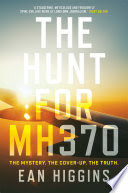
The Hunt for MH370

The hunt for MH370 Ean Higgins

“A staggering, meticulous and frequently spine-chilling work of longform journalism.” Trent Dalton

Somewhere deep beneath the wild seas of the southern Indian Ocean, perhaps in the eerie underwater canyons of Broken Ridge along the Seventh Arc satellite band, lies the answer to the world’s greatest aviation mystery.

Why, on the night of 8 March 2014, did Malaysia Airlines Flight MH370 suddenly U-turn, zig-zag up the Straits of Malacca, then vanish with 239 souls on board?

Was it an elaborate murder-suicide by a rogue pilot? A terrible accident such as onboard fire, rapid decompression or systems failure? A terrorist hijacking gone wrong? Or something else entirely?

Award-winning journalist Ean Higgins has led the world media’s coverage of this incredible saga and draws on years of interviews with aviation experts, victims’ families, air crash investigators and professional hunters across land, sea and sky to dissect the riddle of MH370’s fate.

PRAISE FOR THE HUNT FOR MH370

‘The Hunt for MH370 is a riveting page-turner written with the drama and intrigue of a thriller. Piece by tantalising piece, Ean Higgins unpuzzles this most baffling of mysteries, asking dangerous questions and revealing shocking truths.’ Dick Smith

‘The disappearance of MH370 remains the greatest and most pressing mystery in aviation history that demands answers for both the families of the stricken passengers and the travelling public. No journalist has been more relentless in the pursuit of the truth of MH370 than Ean Higgins. The Hunt for MH370 is an engrossing book in which Higgins has meticulously pieced together the puzzle of the doomed flight from its vanishing to the flawed investigation and the largest maritime search ever that leads the reader to a chilling conclusion that is almost impossible to comprehend.’
Paul Whittaker, Chief Executive Sky News and former editor-in-chief, The Australian

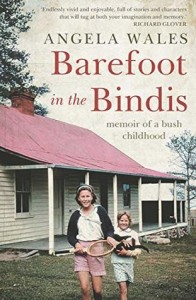
Barefoot in the Bindis: A Memoir of a bush childhood

Barefoot in the Bindis Angela Wales

A circle of pine trees, a sagging wire fence, and a roof that was once painted red.

‘There it is,’ said Dad.

In 1953, after doctors prescribed fresh country air for his health, Scottish-born Robert Wales uprooted his young family from the city life of Sydney and set out to establish a sheep farm in the bush. What he lacked in experience and expertise, he made up for in enthusiasm. Or so he hoped.

When the family arrived on a lonely hill in northern New South Wales, they had no electricity, no running water, no telephone and no choice but to make that tangle of bush their home. From Angela Wales, eldest of the five kids, comes this extraordinarily vivid and evocative account of the next ten years as they tried to tame six thousand acres and navigate the challenges of country life.

Filled with drama and hilarity, joy and back-breaking toil, Barefoot in the Bindis portrays a childhood spent in the bush, and is a sensational picture of Australia past.

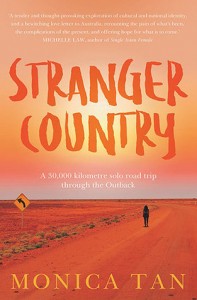
Stranger Country

Stranger Country Monica Tan

Tracks meets Wild in this account of Chinese Australian journalist Monica Tan’s 6 month odyssey though outback Australia.

‘Will I ever really belong to this country? As a Chinese Australian? As a non-Indigenous Australian? . . . I was 32 years old and barely knew the country of my birth. It was time to change that.’

What happens when a 32-year-old first-generation Australian woman decides to chuck in a dream job, pack a sleeping bag and tent, and hit the long, dusty road for six months?

Thirty-thousand kilometres later, Monica Tan has the answer, and it completely surprises her.

In mid-2016, Monica left Sydney, unsure of her place in Australia. As a Chinese Australian city slicker, she couldn’t have felt more distant from powerful mythologies like the Digger, the Drover’s Wife and Clancy of the Overflow. And more importantly, Monica wondered, how could she ever feel she truly belonged to a land that has been the spiritual domain of Indigenous Australians for over 60,000 years?

Stranger Country is the riveting account of the six months Monica drove and camped her way through some of Australia’s most beautiful and remote landscapes. She shared meals, beers and conversations with miners, greynomads, artists, farmers, community workers and small business owners from across the nation: some Aboriginal, some white, some Asian, and even a few who managed to be all three. The result is an enthralling and entertaining celebration of the spirit of adventure, a thoughtful quest for understanding and a unique portrait of Australia and all it means to those who live here.

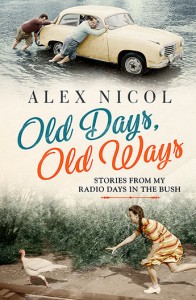
Old Days, Old Ways

Old Days, Old Ways Alex Nicol

Former ABC Radio presenter Alex Nicol brings back to life the voices and stories of regional Australia before television and the internet.

Alex Nicol takes us back to the old days in the bush, when booking into a country pub was likely to turn into an adventure, and when radio was the glue that held far flung communities together.

Full of colourful characters and making do with what’s at hand, these stories are classically Australian. There are the wartime mates who helped each other build farms on their soldier settler blocks, and the ‘Adelady’ keeping the farm running after her husband died. There is the young woman who ran down water buffalo in the Northern Territory, and Possum, the legendary bush hermit who lived off the land on his own for 60 years, quietly doing jobs for farmers without being asked. There is the neighbour caught ‘fishing’ in the chookyard with a long line and a small hook baited with bread, and the little girl who swallowed a sapphire she found on the side of the road.

With a bush yarn, it’s all about the way you tell it. As the voice of rural Australia for over two decades on ABC radio, Alex Nicol can tell a yarn with a punchline that will keep you grinning for the rest of the day.

A Spanner in the Works-The Extraordinary Story of Alice Anderson and Australia’s only All-girl Garage

A Spanner in the WorksLoretta Smith

This is Good Night Stories for Rebel Girls meets Australia’s Sweetheart meets Amelia Earhart. It’s the real-life story of a daring Australian woman who did something extraordinary – then met an early, mysterious end.

From the end of the Great War and into the 1920s, Alice Anderson was considered nothing less than a national treasure. She was a woman of ‘rare achievement’ who excelled as a motoring entrepreneur and inventor. Young, petite, boyish and full of charm, Alice was the only woman in Australia to successfully pull off an almost impossible feat: without family or husband to back her financially, she built a garage to her own specifications and established the country’s only motor service run entirely by women.

Alice was also an adventurer, and her most famous road trip occurred in 1926 in a Baby Austin she had purchased exclusively to prove that the smallest car off a production line could successfully make the 1500-mile-plus journey on and off road from Melbourne to Alice Springs, central Australia.

However, less than a week after her return, Alice was fatally shot in the head at the rear of her own garage. She was only twenty-nine years old. Every newspaper in the country mourned her sudden loss. A coronial inquest concluded that Alice’s death was accidental but testimonies at the inquest were full of inconsistencies.

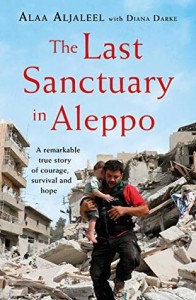
The Last Sanctuary in Aleppo

The Last Sanctuary in Aleppo Alaa Aljaleel with Diana Darke

From Diana Darke, the acclaimed author of My House in Damascus and The Merchant of Syria, comes the extraordinary true story of a heroic ambulance driver who created a cat sanctuary in the midst of war-torn Aleppo.

“I’ll stay with them no matter what happens. Someone who has mercy in his heart for humans has mercy for every living thing.”

When war came to Alaa Aljaleel’s hometown, he made a remarkable decision to stay behind, caring for the people and animals caught in the crossfire. While thousands were forced to flee, Alaa spent his days carrying out perilous rescue missions in his makeshift ambulance and building a sanctuary for the city’s abandoned cats.

In turn, he created something unique: a place of tranquility for children living through the bombardment and a glimmer of hope for those watching in horror around the world. As word of Alaa’s courage and dedication spread, the kindness of strangers enabled him to feed thousands of local families and save hundreds of animals. But with the city under siege, time was running out for the last sanctuary in Aleppo and Alaa was about to face his biggest challenge yet…

This is the first memoir about the war in Syria from a civilian who remains there to this day, providing both a shocking insider account as well as an inspiring tale about how one person’s actions can make a difference against all odds.

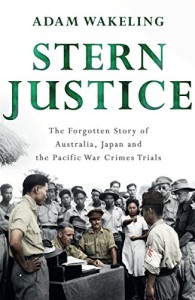
Stern Justice

Stern JusticeAdam Wakeling

If you’re looking for a ripping yarn or a feel good story, you’ve come to the wrong place. The prologue deals with the harrowing reality of an execution. Somehow this kind of death, whether some may deem it justified or not, is simply horrible.

Then you move into the first phase of the book and the word “stern”, which somehow resonated with me, becomes more apparent. In addition to meaning harsh and severe, it also refers to the rear end of a boat, the bit that comes along after everything else and I cannot but think that Adam may have had this in mind while conjuring up the title, for it’s all about the mopping up and apportioning of guilt on the Pacific front after WWII.

I couldn’t help but also reflect on how supreme leaders, the Kaiser in WWI and the Emperor in WWII, got away with it virtually unscathed, protected by some who deemed them worthy. Perhaps the truth lies in the fact that they were both so far removed from reality they really didn’t have a clue about what the battle fronts were like. However, you can’t help but believe that the appointment of General MacArthur to oversee post war Japan was a masterstroke and he, as much as anyone, wanted the emperor alive because of his influence over the psyche of the Japanese people.

As you move into the second of four phases of the book, the legalities and personalities of the legal minds involved in such a massive prosecution come to the fore. The disagreement among lawyers and the convoluted approach to the whole thing takes up many chapters but then one is shaken up again by the testimony of Warrant Officer Bill Sticpewich who survived the unimaginable horrors of the Sandakan death march. That the camp commandant Hoshijima was in denial about his appalling treatment (though “appalling” seems wholly inadequate for this man) says a lot about the mentality of the Japanese military machine. Added to that was Captain Takakuwa’s cruelty during the march. They really were out of touch with reality and brutality on an extreme scale, for them, was normal. There was also the fact that many Japanese viewed martyrdom as something to be proud of.

Then there’s Banaba Island on Kiribati, where 200 locals were executed 4 days after the war ended. The atrocities here were also committed by other nationalities, such as Formosan (now Taiwanese) who were coerced into assisting the Japanese, occasionally willingly, mostly for survival. Their trials took place in Rabaul, completely under the control of Australia at that time, so it was an all Australian affair.
During the trails, the fact that Russia had perpetrated most of what Japan was accused of doing and yet went unpunished was raised more than once. It is claimed, with some right, that more died in Russian captivity than in Japanese captivity yet they got off scot free.

Questions were also raised about Australian troops raping Japanese women with gay abandon. How quickly we are reduced to animal behaviour!

Of course, WWII was now over and, with each succeeding month, interest in retribution continued to wane as people got on with their lives and moved ahead. Prosecutions and come-uppance were the province of those who had gone through the war at the coal face and knew the reality of what had been, but then the Korean War surfaced and became the more immediate concern.

The final round at Manus Island is also covered and an interesting concluding chapter looks at the rights and wrongs of the whole affair; like how one accused man was released and later became prime minister of Japan.

It’s a detailed document that will appeal to those interested in war and its side effects and gives insightful information into realities often overlooked.


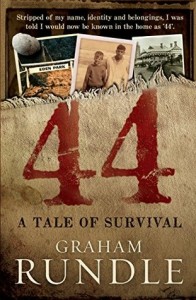
Forty-four: a tale of survival

Forty-four- a tale of survival Graham Rundle

Seven-year-old Graham Rundle was excited to learn he was going for a holiday at a place where he’d have a chance to play with lots of other boys. A few days later, his father dropped him off at Eden Park, a Salvation Army boys’ home outside Adelaide in South Australia.

As soon as his father left, Graham’s few possessions were taken away and he was given old clothes to wear. From now on, he was told, he’d be known around the home simply by his number, ‘44’. When he pleaded to go home, he was told that nobody wanted to take him. He’d been abandoned by his family – even, it seemed, by the grandmother he loved.

This book vividly portrays what happened to Graham over the eight years he spent at Eden Park, living in fear of abuse by his peers and by the men who were supposed to care for him. It captures his extraordinary resilience, determination and humour, and his debt to the loving nana who tracked him down against the odds and offered him hope in the midst of hell.

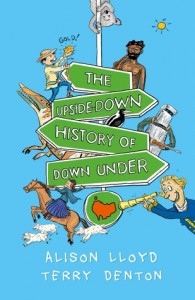
The Upside-down History of Down-under

The Upside-down History of Down Under Alison Lloyd and Terry Denison

The true story of Australia starts with a piece of land that went for a swim. Millions of years ago it floated away from Africa. Very, very, slowly. It was home to dinosaurs and giant animals, until the first Australians showed up and got comfortable.

This wild and wonderful land was a mystery to the rest of the world. Then the English decided to make it the biggest jail ever . . . Experience the story of Australia from prehistory to federation in 1901.

3 Main St Buderim - QLD 4556
(07) 5445 3779